
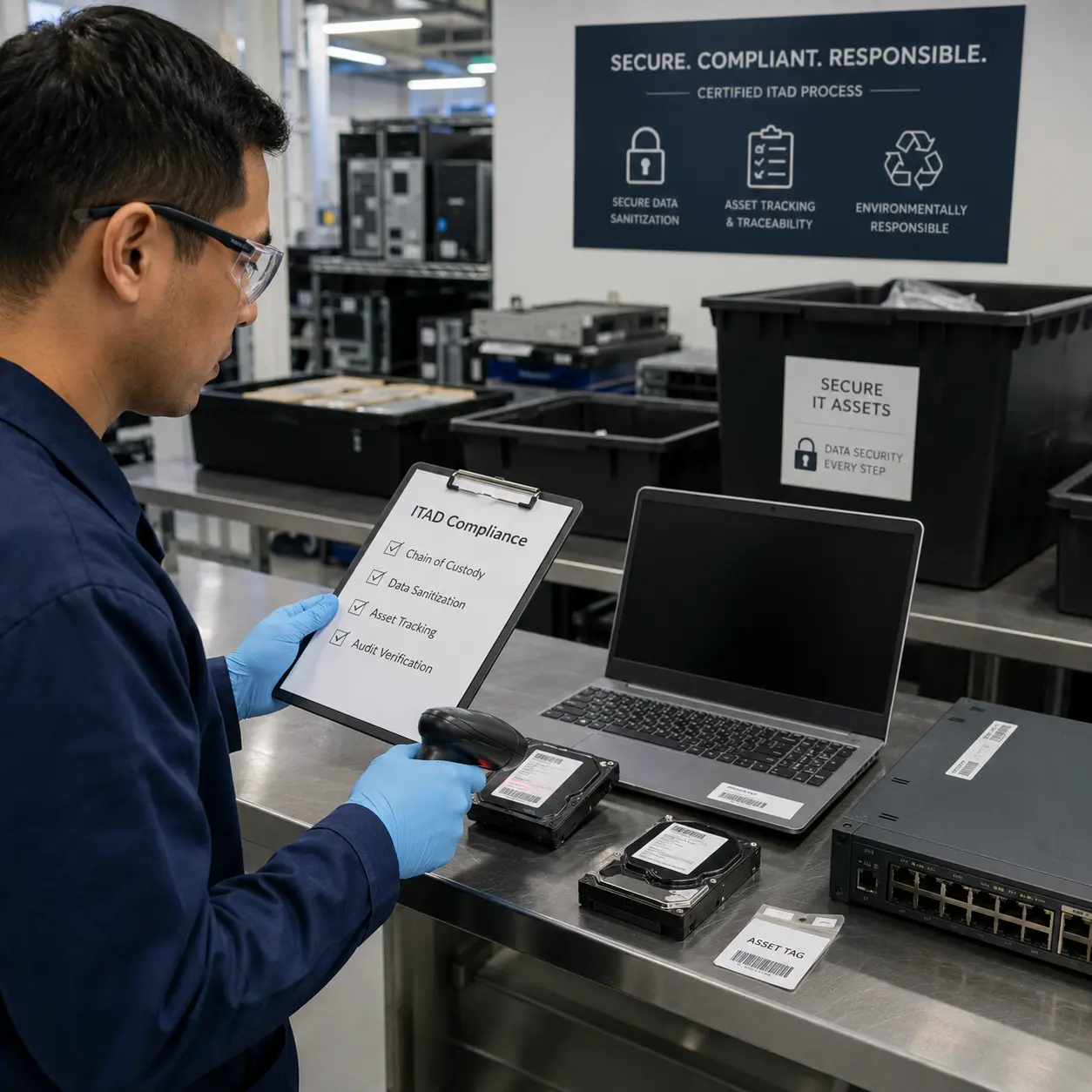
ITAD certifications and compliance standards help businesses verify that retired IT assets are handled securely, responsibly, and with a documented chain of custody. From R2v3 and NAID AAA to ISO and NIST standards, these frameworks address everything from data destruction and asset tracking to environmental responsibility and operational controls.
TL;DR
- ITAD certifications independently verify that a provider securely and consistently manages retired IT assets.
- Certifications such as R2v3 and e-Stewards focus on responsible reuse, recycling, environmental protection, and downstream vendor oversight.
- NAID AAA and ADISA emphasize secure data destruction, sanitization, and protection against data recovery.
- ISO certifications support broader quality, environmental, workplace safety, and information security management.
What Is an ITAD Certification?
An ITAD certification is a third-party validation that a provider follows strict standards for the secure and sustainable retirement of IT assets. Credentials such as R2v3 and NAID AAA demonstrate that a provider’s audited processes meet defined requirements for data security, environmental responsibility, and operational control.
These standards reduce data exposure and compliance risks while helping customers maintain audit-ready records.
What Is ITAD Compliance?
ITAD compliance is the documented process governing the disposition of data-bearing IT hardware, from decommissioning until its final state (resale, refurbishment, recycling, or disposal). A compliant program ensures that every step is auditable, providing a transparent chain of custody and verifiable evidence that data was securely sanitized or destroyed in accordance with applicable legal, contractual, and organizational requirements.
Why ITAD Compliance Is Non-Negotiable
ITAD compliance protects organizations from the legal, financial, environmental, and reputational risks of retiring data-bearing hardware.
It ensures assets are securely sanitized, responsibly processed, fully documented, and traceable from decommissioning through reuse, destruction, or recycling.
More precisely, ITAD compliance:
- Protects sensitive data
- Supports regulatory compliance
- Provides audit evidence
- Prevents environmental harm
- Supports sustainability goals
- Strengthens accountability
- Protects brand reputation
Why Do Certifications Matter in ITAD?
ITAD certifications serve as a “trust shortcut” in a high-stakes industry. They deliver independent confirmation that an ITAD provider’s facilities, employees, and operational processes have been assessed against rigorous benchmarks.
By choosing a certified ITAD provider, you strengthen your due diligence and can more confidently verify that the provider follows recognized industry practices relevant to your legal, security, and environmental obligations.
How Do ITAD Providers Maintain Compliance With Certifications and Standards?
ITAD service providers must regularly review updated requirements from certification and standards organizations such as i-SIGMA and SERI. They should also maintain a quality management system that includes periodic internal and external audits, identifies gaps in disposal workflows, and keeps procedures aligned with current technical standards and certification requirements.
ITAD Standards vs. Certifications: What’s the Difference?
ITAD certifications and compliance involve three distinct areas:
- Certifications: Credentials earned by an ITAD provider after successfully completing a third-party audit. They confirm that the provider’s operations meet the requirements of a specific certification program.
- Technical standards: Documented guidelines, such as NIST SP 800-88, that define how technical processes – including data sanitization – should be performed.
Key ITAD Certifications
When evaluating a partner, you should look for several core credentials that define a certified ITAD provider:
-
R2v3 Certification
Managed by SERI (Sustainable Electronics Recycling International), this is a widely recognized standard that focuses on responsible IT reuse – rather than being prematurely recycled or smashed.
An R2v3-certified ITAD company must maintain documented controls for asset handling and data security while verifying that applicable downstream vendors meet defined qualification requirements.
-
e-Stewards 4.1 Certification
This standard focuses on ethical recycling and social responsibility. It prohibits the export of hazardous waste to developing nations and bans the use of non-ethical labor (child, forced, or prison labor), making it ideal for organizations with strong ESG mandates.
-
i-SIGMA NAID AAA Certification
This global benchmark focuses entirely on data security, ensuring nobody steals your data-bearing hard drives. It involves both scheduled and unannounced audits to verify that physical and digital destruction processes are secure and that employees are properly screened.
-
ADISA Certification
This UK-based but globally recognized standard is informed by technical and forensic research that provides a rigorous risk management assessment for IT asset disposal, guaranteeing that data cannot be recovered using laboratory tools.
It essentially verifies that a provider follows disciplined processes for securely wiping or destroying data while maintaining environmental responsibility.
ISO Certifications for ITAD Providers
ISO standards provide a broad framework for organizational excellence and accountability:
-
ISO 9001 (Quality Management)
This certification proves a provider has repeatable, auditable processes in place. Note that ISO 9001 is currently being revised, with publication expected in late 2026.
-
ISO 14001 (Environmental Management)
ISO 14001 ensures hazardous materials are managed legally and recycling aligns with sustainability goals. ISO 14001:2026 transitions will be underway following its latest 2026 publication, which will strengthen focus on resource efficiency and value-chain impacts.
-
ISO 45001 (Occupational Health and Safety)
ISO 45001 provides a structured framework for identifying occupational hazards, controlling workplace risks, and improving health and safety performance.
-
ISO/IEC 27001 (Information Security Management)
ISO/IEC 27001 establishes a structured information security management system for identifying and controlling data-security risks.
ITAD Certification Comparison
This ITAD certification comparison can help you identify which provider aligns with your specific needs, depending on their primary focus:
- R2v3: Comprehensive lifecycle tracking and material recovery.
- e-Stewards: Ethical assurance and strict environmental export bans.
- NAID AAA: Verified, audit-ready data destruction.
- ADISA: High-assurance data sanitization and asset recovery risk management.
- ISO Standards: Organizational governance and continuous improvement.
Common ITAD Data Sanitization Standards
Technical standards and guidance define recognized approaches for rendering data unrecoverable.
-
NIST SP 800-88 Rev. 2
This is the primary benchmark for sanitization, defining three outcomes:
- Clear: software erasure
2. Purge: advanced techniques like cryptographic erasure
3. Destroy: physical disintegration
-
IEEE 2883 and IEEE 2883.1
These modern standards provide technology-specific guidance for selecting and applying sanitization methods to logical and physical storage. When appropriate, these methods can support secure media reuse instead of unnecessary physical destruction.
Additional Compliance Requirements for ITAD Providers
Beyond data-security requirements, ITAD providers must also address environmental and international waste regulations:
- RCRA and Hazardous Waste: Regulates the handling of certain batteries and mercury-containing equipment often found in electronics.
- International Shipments and the Basel Convention: Governs the ethical movement of e-waste across borders to prevent dumping in developing nations.
- Sustainability and ESG Reporting: Certified ITAD providers can supply documented data on reuse, recycling, material recovery, and final disposition to support organizational sustainability reporting.
What Certifications Should I Look for in an ITAD Provider?
When vetting an IT Asset Disposition (ITAD) provider for your business, you should look for certified facility credentials that address data security, environmental sustainability, and operational quality.
No single certification covers everything perfectly. For maximum compliance protection, the “sweet spot” strategy for U.S. procurement and risk managers is a dual-certified provider that holds:
- R2v3 and/or e-Stewards 4.1, to cover the environmental, asset tracking, and recycling lifecycle
2. i-SIGMA NAID AAA, to guarantee the physical security and destruction of the data media.
Strengthen ITAD Compliance With a Certified Disposition Partner
ITAD compliance is not a box checked at pickup. It requires documented proof at every handoff.
Green Wave Electronics operates an R2v3-certified IT asset disposition program covering responsible reuse, recycling, data security, chain of custody, and downstream management.
Our ISO 9001, ISO 14001, and ISO 45001 certifications support consistent quality, responsible environmental management, and occupational health and safety across our operations.
We also refurbish and remarket eligible assets in-house, helping businesses recover maximum value from decommissioned IT equipment. Start your ITAD program today.