
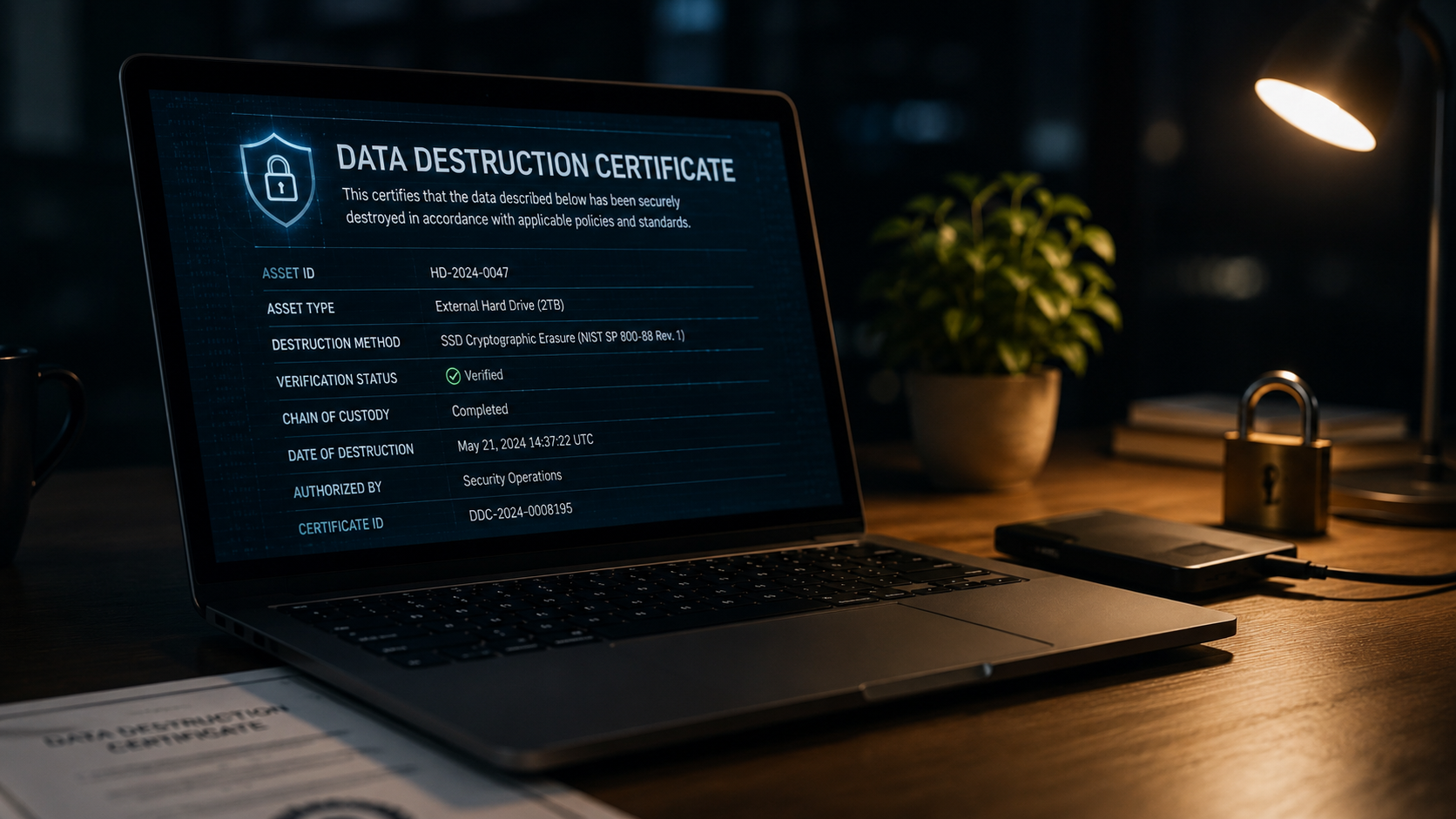
When an IT asset leaves your organization – whether it is being decommissioned, resold, or recycled – any data it holds, or once held, remains your responsibility until its destruction can be formally verified.
A data destruction certificate is the document that formally addresses that compliance requirement by confirming how, when, and by whom the data was destroyed.
What Is a Data Destruction Certificate?
For electronics, a data destruction certificate is a formal document issued by an accredited party confirming that any sensitive data stored on an organization’s IT equipment, including hard drives, servers, mobile devices, etc., has been rendered permanently unrecoverable.
In essence, a Data Destruction Certificate documents that:
- The destruction process followed industry-recognized and approved protocols.
- The results were verified to meet applicable regulations, internal security policies, and technical standards.
- Every asset was tracked through a documented chain of custody from the moment of pickup to final disposal.
The certificate is the last step in any responsible IT asset disposition (ITAD) program: the documented point at which your organization can demonstrate that data-bearing assets were handled properly and that residual data risk was addressed.
Why Is a Data Destruction Certificate Important?
Without a certificate of data destruction, your company cannot demonstrate that sensitive data was properly handled after a device left its control.
Inability to prove compliant data sanitization may result in significant fines, audit failures, and reputational damage.
Benefits of a Certified Data Destruction Service
A certified data destruction service provides secure data sanitization and the documentation needed to prove it. In more detail, it:
Reduces Liability
Provides documented proof from a qualified or certified provider that data was securely erased before the device was transferred, recycled, or destroyed.
Supports Compliance
Helps organizations meet requirements under privacy and data protection rules, including HIPAA for protected health information, the FACTA Disposal Rule for consumer report information, PCI DSS for payment card environments, and other applicable standards.
Protects Client Trust
Reinforces confidence by confirming that asset disposition followed recognized data security and documentation standards.
Creates A Clear Audit Trail
Supports responsible end-of-life management by ensuring that certified data destruction and compliant electronics recycling are documented as part of the same disposition process.
Certificate of Data Destruction: Must Have Elements
A certificate of data destruction may cover a single device or an entire batch of assets – grouped by collection event, pickup date, job number, or site.
Regardless of how devices were collected or grouped, each must be listed individually and include the following fields:
1. Unique Certificate ID
A serialized transaction number for tracking and verification, linking the certificate to a specific project or batch for future retrieval and cross-referencing.
2. Serialized Asset List
Every device is identified by its individual serial number, asset tag, make, and model. Without these, a certificate cannot be tied to specific equipment, which can weaken the audit trail if a device later surfaces with recoverable data.
3. Destruction Method
The exact method used to render data unrecoverable, such as physical shredding to a specific particle size, degaussing, or software-based wiping, with the applicable standard named explicitly where relevant.
For example:
-
NIST SP 800-88 Rev. 2 Clear
A logical sanitization method for user-addressable storage areas, suitable for lower-risk reuse scenarios where protection against simple, non-invasive recovery is sufficient.
-
NIST SP 800-88 Rev. 2 Purge
A stronger sanitization method that makes recovery infeasible even with state-of-the-art laboratory techniques, preferred for sensitive data or devices leaving organizational control.
-
IEEE 2883-2022
The technical standard cited by NIST SP 800-88 Rev. 2 for guidance on applying sanitization techniques across modern storage media.
Vague terms such as “processed” or “recycled” are red flags.
4. Erasure Software Name and Version
When data sanitization is software-based rather than physical, the name and specific version of the tool used should appear on the certificate.
Different software versions may support different security standards and verification methods, so the version number is what makes the claim verifiable.
5. Erasure Result / Status
A pass, fail, destroyed, or exception result for each individual device.
A certificate that does not distinguish between completed, failed, and exception cases offers incomplete assurance.
6. Date, Time, and Location
The precise date and time the destruction took place, and the physical address of the facility where it was carried out.
Such details support timeline reconstruction during compliance audits and legal proceedings.
7. Verification and Validation, Where Required
Confirmation that the erasure or destruction was verified post-process, not just initiated.
Verification confirms that the selected sanitization or data destruction method was successfully completed.
Validation, where required by the applicable standard, client policy, or internal procedure, provides an additional check that no recoverable data remains.
The certificate or supporting records should document both steps when both apply.
8. Chain of Custody Reference
A reference number or documented trail linking the certificate to the secure transport and handling logs that preceded processing.
This connects the certificate to the full asset lifecycle, from pickup through final disposition.
9. Authorized Signatures
Names and signatures of the technician, authorized provider representative, or certifying official responsible for the result.
If the provider uses separate performer and verifier roles, both should appear on the certificate or be traceable in the supporting records.
10. Provider Details and Certifications
The name of the certified data destruction service and its active certifications, such as:
- NAID AAA – the leading U.S. certification for data destruction providers, verified through unannounced audits.
- R2v3 – the leading responsible recycling certification for U.S. electronics recyclers and ITAD providers.
- e-Stewards – a responsible electronics recycling certification with data security requirements.
- ISO 9001 – the international standard for quality management systems.
Provider credentials on the certificate help document the client’s due diligence in vendor selection, especially for organizations subject to HIPAA, PCI DSS, SOX, FACTA, GLBA requirements (for financial institutions), or state privacy requirements.
Additional Records That Complete the Picture
These elements sit outside the certificate itself, but they are part of a secure disposition documentation program.
Hardware Diagnostic Report
In some cases, certified data destruction services include a hardware diagnostic report alongside the erasure certificate, documenting the functional condition of each asset – such as CPU, memory, and storage health – at the time of processing.
This diagnostic report and the erasure certificate together give organizations a single auditable record covering both what happened to the data and the physical state of the asset – particularly valuable when equipment is being evaluated for reuse or remarketing.
Certificate Retention Period
This is usually not a field on the certificate itself, but it is a critical compliance consideration.
Retention requirements vary by regulation, contract, and internal policy:
- HIPAA-related documentation may need to be retained for at least six years.
- SOX (Sarbanes-Oxley) audit records for publicly traded companies may need to be retained for seven years.
- PCI DSS does not set a fixed retention period for destruction records but requires organizations to define and document their own retention policy.
For audit logs, PCI DSS mandates a minimum of 12 months retention, with the most recent three months immediately accessible for analysis.
Many organizations retain certificates indefinitely. Confirm your provider issues both a physical and a digital copy for long-term storage and quick retrieval.
When Does Your Company Need a Data Destruction Certificate?
If data-bearing IT assets have left your organization by any route – disposal, sale, lease return, or recycling – you need a data destruction certificate for each one.
Consider whether any of the following applies to your organization:
- You have decommissioned, sold, returned leased equipment, or recycled equipment that previously held customer, employee, or business data.
- Your organization is subject to HIPAA, CCPA (California Consumer Privacy Act), GDPR (Europe’s General Data Protection Regulation), or any other data protection regulation that requires proof of secure data disposal.
- You hold or process sensitive financial, health, personal, or government data.
- Your organization undergoes regular internal or external audits, where data handling practices are reviewed.
In all such cases, lacking proper data destruction documentation is more than a security gap. It may also put the organization at risk of violating applicable data protection laws.
What Happens If You Don’t Have a Data Destruction Certificate?
Without documented proof of secure destruction of data, your organization faces:
- Regulatory penalties: Under GDPR, HIPAA, and similar frameworks, the inability to demonstrate compliant data disposal can trigger fines, enforcement actions, and mandatory audits.
- Legal liability: If a decommissioned device later surfaces with recoverable data, the absence of a certificate makes it significantly harder to demonstrate due diligence in court.
- Failed audits: Internal and external auditors typically require a complete documentation trail. A missing certificate of data destruction is a common audit finding that can delay or derail compliance reviews.
- Reputational damage: A data breach traced back to improperly disposed equipment carries consequences that go well beyond any regulatory fine.
Why Not Just Destroy the Data Yourself?
It can be tempting to handle data destruction in-house to reduce cost and maintain control.
However, doing so carries risks that outweigh the short-term savings. Here’s why:
-
Standard deletion is not destruction
Deleting files or performing a factory reset does not remove data at a forensic level. Recoverable remnants can persist on both HDDs and SSDs without proper overwrite procedures.
-
Physical destruction without process controls is unreliable
Shredding or crushing hardware in-house may leave recoverable shards, and without a documented chain of custody, there is no way to prove the work was done correctly.
-
Internal processes cannot produce a valid document of data destruction
Only an accredited third-party certified data destruction service can issue a certificate that carries legal and compliance weight.
-
Human error and mishandling
Equipment containing sensitive data can be mishandled by staff, go missing during internal transit, or processed inconsistently without the controls a professional ITAD provider brings.
So, the process should be handled by a reputable certified provider, such as Green Wave Electronics, using compliant, pre-approved procedures that align with recognized sanitization and destruction standards.
The resulting certificate should be tamper-evident, serialized, and tied to specific assets, making it defensible in an audit, compliance review, or legal context.
Certified Data Destruction Service: Documented From Pickup to Certificate
A certified provider does more than wipe or shred devices. It creates a documented, verifiable record that follows each asset from pickup through final certificate issuance.
Green Wave Electronics issues Certificates of Destruction alongside Proper Recycling and Asset Disposition reports for every ITAD engagement. Together, these records show which assets were processed, which method was used, and when the work was completed.
Operating under R2v3, ISO 9001, ISO 14001, and ISO 45001 certifications, Green Wave Electronics follows an audited workflow with serial number tracking from intake to final disposition, whether assets are routed for secure disposal, resale, recycling, or refurbishment.
Compliance should not end with proof of destruction. It should also support responsible recovery and a greener electronics lifecycle. Contact us today.