
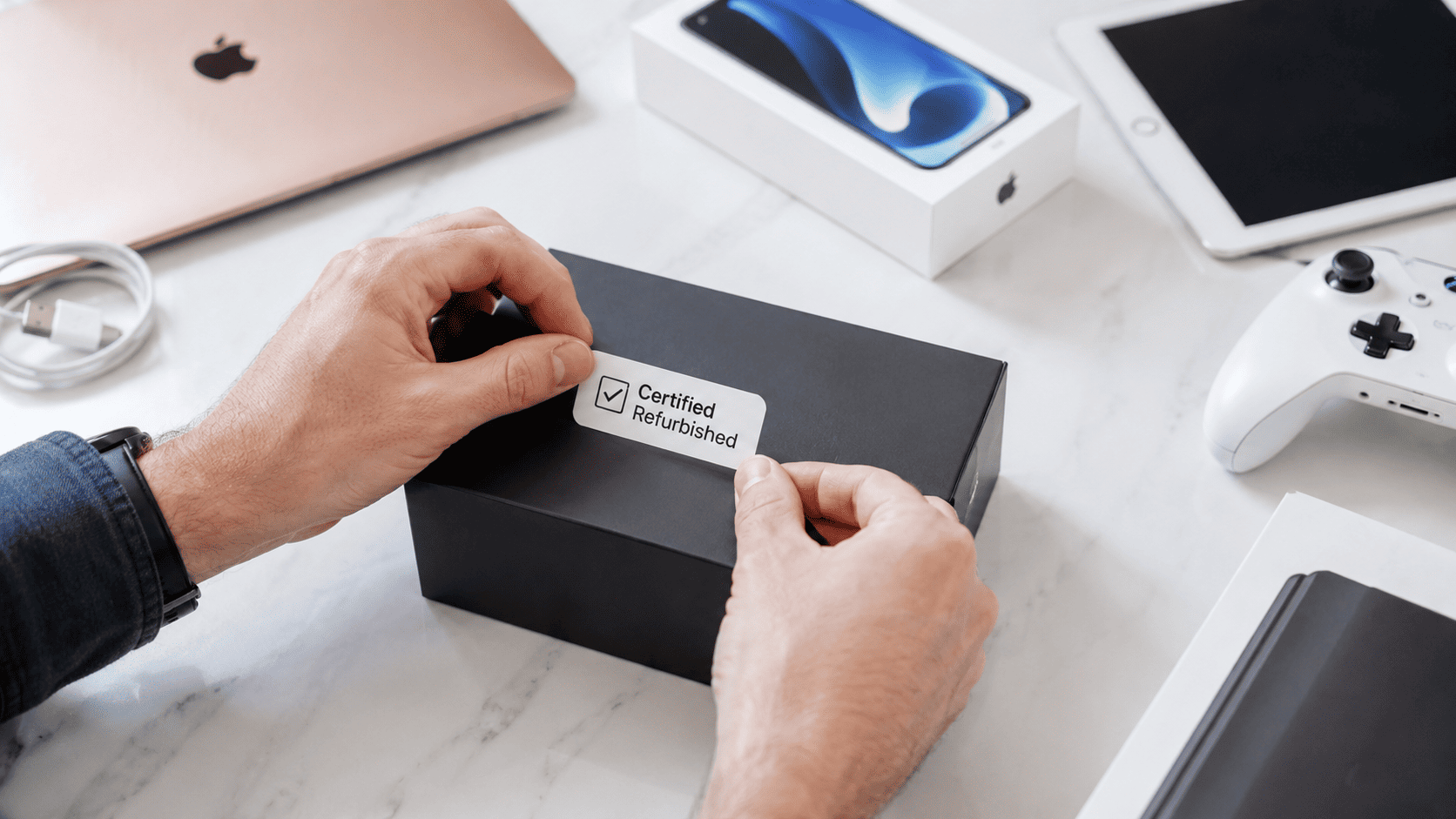
Not all refurbished products are created equal. Certified refurbished devices give a higher level of confidence to shoppers – covering how a device was processed, who stands behind it, and what protection the buyer actually has. That, in essence, is also the core difference between refurbished and certified products.
What Is Refurbished?
A refurbished product is a device that has gone through some level of professional restoration before being offered for resale. That process can include inspection, functional testing, repair, cleaning, cosmetic touch-ups, and repackaging.
Depending on the device’s condition and the seller, the depth of refurbishment and the process vary. For example, in some cases, a refurbished phone may only need a factory reset and light cleaning. In others, it may require component replacement and more extensive cosmetic restoration.
What Is Certified Refurbished?
Certified refurbished means that a pre-owned or used product has passed through a structured, documented restoration process managed by either the original manufacturer or a vetted third-party refurbisher. The result is a more trusted condition grading and, usually, a longer warranty.
At its core, what separates certified refurbished from general refurbished is the accountability layer. There is a defined standard – a checklist of inspection steps, performance thresholds, and quality benchmarks – that the product must meet before it can carry the certified label and its equivalent refurbished grade, A, B, or C.
For electronics sellers or resellers, certified refurbished products carry lower return risk and stronger buyer confidence than a generically labeled refurbished item, because the certification creates a traceable quality record.
In practice, that standard often comes down to how thoroughly each unit is tested. Units bound for a certified label typically go through Level 1 testing – a full functional test of every device rather than a visual check alone – so the certification reflects verified performance, not just cosmetic condition.
Renewed vs. Certified Refurbished
The term renewed is primarily associated with Amazon’s quality-driven refurbished marketplace program, Amazon Renewed. Listings commonly include pre-owned, refurbished, and open-box electronics such as smartphones, computers, tablets, and game consoles, as well as kitchen appliances, office products, power tools, and other eligible products sold by qualified suppliers.
Plus, products listed here must come with the Amazon Renewed Guarantee – typically one year for Renewed Premium products and 90 days for standard Renewed items.
Certified refurbished, on the other hand, is a broader term that can refer to manufacturer programs (such as Apple Certified Refurbished), marketplace programs (including eBay Refurbished’s Certified tier), or authorized third-party refurbishers operating under defined standards – like Green Wave Electronics.
The core difference is scope:
- Renewed is an Amazon program for refurbished products with its own grading and guarantee structure
- Certified refurbished is a quality-assurance category that spans multiple programs and channels for refurbished devices.
A non-new product can be both – listed as ‘Renewed’ on Amazon while also having been certified through a manufacturer’s own refurbishment process.
What’s the Difference Between Refurbished and Reconditioned?
These two terms are frequently used interchangeably, but there is a subtle distinction worth noting.
Refurbished typically refers to the process of restoring a product to working order – testing, repairing, cleaning, and repackaging so it performs as expected.
Reconditioned, by contrast, often implies a more thorough intervention: the device is not just returned to working condition but is restored more comprehensively, sometimes to a standard closer to the original specification.
In practice, the term usage varies by manufacturer and marketplace. The key question to ask when evaluating either label is: who performed the work, what standard did they follow, and is there a warranty?
Is Certified Refurbished Trustworthy?
Yes, certified refurbished products from reputable sellers are a reliable option. In fact, the trustworthiness of a certified refurbished product is tied directly to the credibility of the certifying party and the specifics of what the certification covers.
Manufacturer-certified programs – such as those run by Apple, Dell, or Samsung – carry the highest level of assurance, because the original manufacturer controls the standard, the parts, and the process.
Authorized third parties sit at a similar tier – especially those offering decent warranties of a minimum of 1 year, ideally 2 years.
That said, even the strongest certification only goes as far as the buyer’s understanding of it.
Merchants must explicitly communicate what a certification covers – warranty length, testing standards, and return policy – to build the trust that drives conversion, particularly when selling to broader demographic segments.
Refurbished Electronics Market Demographics
Refurbished products are becoming increasingly popular – especially among younger generations. Recent consumer data show that nearly half (47%) of Gen Z shoppers actively seek out refurbished or secondhand tech to reduce e-waste.
That figure drops to 18% among Baby Boomers and 25% among Gen X.
Consumers over 50 are 30% less likely to consider a refurbished purchase than younger buyers.
The market reflects this broader adoption trend: the global refurbished electronics sector is projected to reach $27.4 billion in 2026, growing to $40.8 billion by 2035 at a 4.53% CAGR, driven, in part, by sustainability-conscious purchasing across both consumer and enterprise segments.
What’s the Advantage of Buying a Certified Refurbished Product?
For end buyers, the primary advantages are cost and coverage. Certified refurbished devices sell at a lower price than an equivalent new product – with the added protection of a warranty that, depending on the program, can range from 90 days to two years.
For sellers, certified refurbished products carry clearer condition documentation, which reduces disputes at delivery and simplifies returns processing. Plus, they are more easily listed on premium marketplace programs and sell at higher average prices than non-certified models.
For the environment, extending a device’s lifecycle can significantly reduce its climate impact. A single refurbished phone, for instance, produces a mere 7.61 kg CO2-e compared with 85.2 kg for a new smartphone, which works out to roughly 91% lower emissions, a number that carries real weight for businesses with active ESG commitments.
Why the Certifying Party Makes All the Difference
Behind every trustworthy certified label is a party accountable for the standard: who sets it, who enforces it, and what happens when a product doesn’t meet it. For electronics merchants, that is often the difference between a reliable resale operation and a costly returns problem.
Green Wave Electronics provides certified refurbishment and end-to-end reverse logistics services built specifically for consumer electronics brands.
Every refurbished device follows a structured recovery process, from testing and inspection to repackaging, designed to meet the quality standards required by programs like Amazon Renewed and eBay Refurbished.
With over 15 years of hands-on electronics experience, at Green Wave Electronics, we manage the complete product lifecycle: from the moment a device comes back, to the moment it leaves our facility graded, certified, and ready for resale. Not just processed but positioned to sell.
The label matters. So does who’s behind it. Talk to our team.
FAQs
A certified refurbished device is verified against a defined standard before it can carry the label. In practice, that usually means Level 1 testing – a full functional test of the device, not just a visual inspection – so its performance is confirmed rather than assumed. The certifying party sets and documents that standard, which is what separates certified refurbished from a generically labeled refurbished item.
Yes. Under a credible certified program, each unit is individually tested rather than spot-checked by batch. When every device is put through full Level 1 functional testing, the certification reflects verified condition on that specific unit – which is what keeps return rates down and buyer confidence up.