Today, demand for server disposal services is growing, driven largely by continuous technology refresh cycles.
With the average “first life” of a server now approximately four years, many units, once retired, move into ITAD pathways such as parts harvesting, certified recycling, or raw material recovery.
The Hard(ware) Facts
- Server disposal covers the controlled retirement of old or out-of-service hardware.
- Retired servers may contain valuable metals, hazardous materials, and sensitive business data.
- Secure decommissioning and data sanitization reduce data exposure risk.
- Server recycling helps recover usable materials, reduce waste, and keep hazardous components out of the landfill.
- Disposal documentation is essential for compliance, audits, and chain of custody.
- A compliant ITAD partner should handle the documented logistics, data destruction, and recycling or disposal workflow for old servers.
What Is Server Disposal?
Server disposal is the structured process of retiring old, decommissioned, or obsolete hardware for repurposing, reusing, recycling, or responsible component disposal.
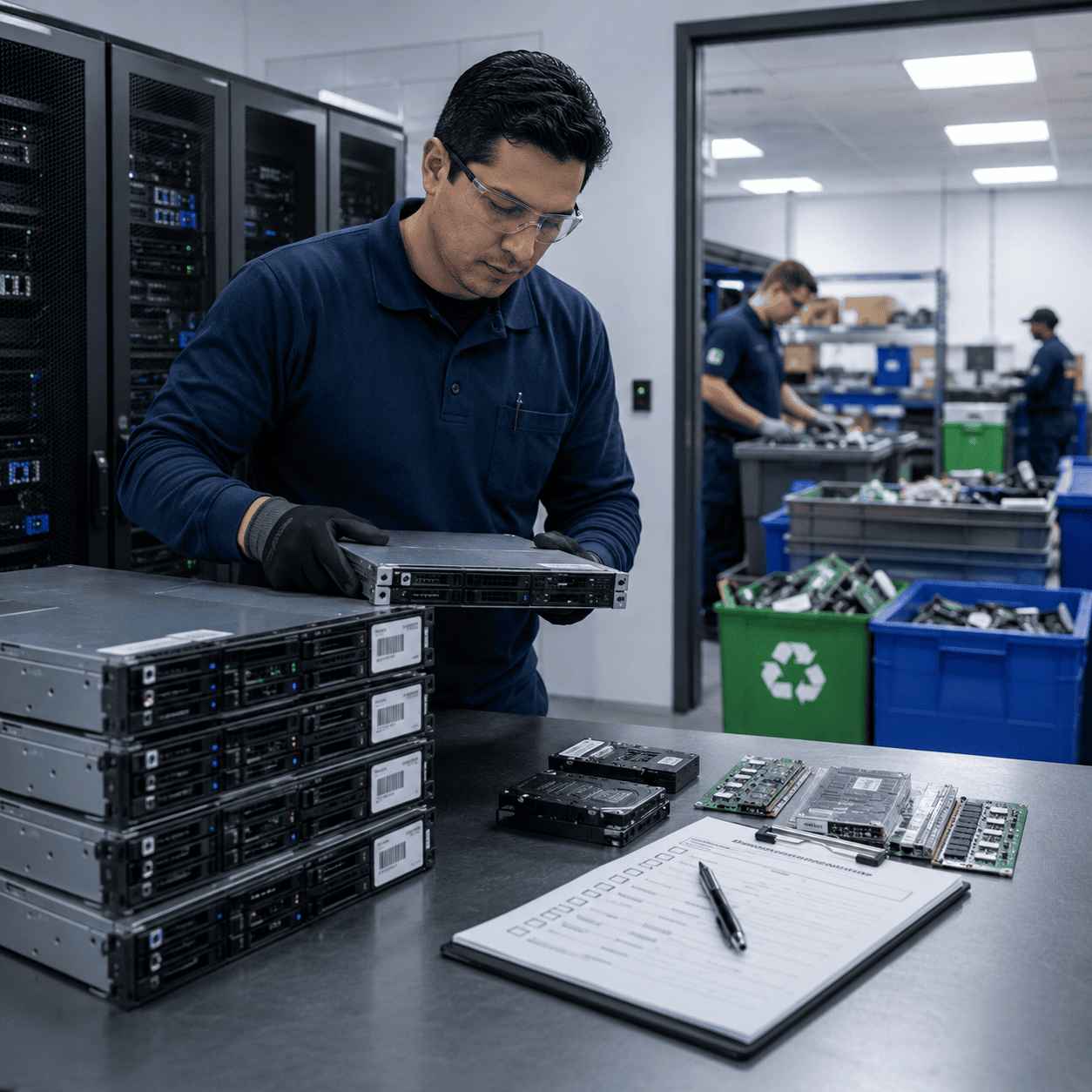
Secure and compliant server disposal follows a structured workflow that includes server decommissioning, de-racking, asset logging, data destruction, transport, recycling, and materials recovery.
Why Proper Server Disposal Matters
Retired servers are not just old machines. They can contain recoverable metals, hazardous materials, and sensitive business data.
Proper server disposal helps reduce environmental harm, protect confidential information, maintain compliance, and recover value from hardware that still has a useful second life.
Why You Can’t Just Throw Away Old Servers
Sending retired hardware to a landfill may be restricted or even prohibited depending on the state.
Today, electronic waste accounts for only about 2% of landfill volume in the U.S., according to EPA estimates. Yet its environmental impact is disproportionately high, as e-waste is responsible for roughly 70% of the toxic heavy metals found at those sites.
Among other benefits, proper server disposal helps divert hazardous materials from the waste stream and recover valuable metals for future manufacturing.
Common Materials Found in Servers
A single server is a complex assembly of both valuable and potentially hazardous substances, including:
- Precious metals: Gold, silver, and palladium found in connectors and processors.
- Common metals: Steel, aluminum, and copper used in chassis and wiring.
- Toxic materials: Lead, mercury, cadmium, and beryllium found in certain electronic components.
Without a responsible server disposal strategy, toxic materials can pose significant risks to the environment and public health, while valuable metals may be lost instead of recovered and reused.
However, for organizations such as data centers, healthcare providers, financial institutions, and enterprise IT teams, responsible server disposal also carries another layer of risk: data exposure.
The Security and Operational Risks of Server Disposal
For businesses, the risk does not stop at environmental impact. One of the biggest risks in disposing of company servers is a data breach.
Servers can retain sensitive customer records, financial files, login credentials, internal documents, and proprietary intellectual property long after they have been taken out of use.
Decommissioning Is Where Secure Server Disposal Starts
The security risk begins before a server ever leaves the building. Once hardware is removed from active use, it needs to be handled through a controlled decommissioning process.
The server decommissioning process starts with visibility. Each server should be logged by serial number, location, configuration, and ownership status so the organization knows exactly what is being retired.
Then, teams need to ensure that the server is no longer supporting live workloads, back up essential files to encrypted storage, deactivate network services, unassign IP addresses, and remove internal credentials.
Data Sanitization Anchors Secure Server Disposal
Secure server disposal requires certified wiping, such as methods aligned with NIST 800-88, or physical destruction when drives cannot be safely erased. Every step must be documented with proper asset logs, wipe certificates, disposal receipts, and chain-of-custody records.
In this way, organizations turn server disposal from a risky cleanup task into a controlled and compliant process.
Once data has been sanitized and documentation is complete, the old server can move to reuse, resale, parts harvesting, certified recycling, or final materials recovery.
Server Recycling: Eco-Friendly Disposal That Reduces Waste
Server recycling is one of the most eco-friendly server disposal methods when hardware can no longer be reused, resold, or refurbished. It prioritizes resource recovery and environmental protection over simple waste elimination.
The server recycling process follows a planned sequence of technical and physical stages designed to maximize recovery while keeping hazardous materials out of the waste stream.
Core Phases of the Server Recycling Process
After server decommissioning and data sanitization, old servers are transferred to the appropriate server recycling facility.
Logistics and Hazard Triage
Professional server disposal services maintain a secure chain of custody during transport to the processing facility. This continues the same documented process started during data sanitization, ensuring each asset remains traceable from removal to final disposition.
Upon arrival, the receiving team performs hazard triage.
For servers, this may include separating circuit boards, batteries, and other components that require controlled handling under responsible recycling standards.
These materials are managed carefully to prevent contamination, protect workers, and support safe downstream recovery.
Demanufacturing and Manual Disassembly
Trained technicians perform demanufacturing, dismantling the servers to extract high-value, reusable parts.
Components with remaining life-such as GPUs, CPUs, and high-capacity RAM-are often separated for the refurbishment market, which significantly reduces the energy required for new manufacturing.
Industrial Shredding and Material Separation
Remaining materials that cannot be reused are processed through industrial shredders, using techniques like magnetic separation for ferrous metals and eddy current separation for non-ferrous metals like aluminum and copper, to isolate raw materials.
Commodity Recovery and Documentation
The final step is the refinement of separated materials into clean commodity streams of steel, plastic, and precious metals.
To close the loop, the facility issues a Certificate of Destruction or Responsible Recycling, providing formal proof for audits and ESG (Environmental, Social, and Governance) reporting.
Choosing a Server Disposal Partner
The right server disposal partner should give you more than pickup and recycling.
Look for an ITAD service provider that can document data destruction, maintain chain of custody, recover asset value where possible, and ensure retired hardware is handled responsibly from collection to final disposition.
What a Compliant Server Recycling Vendor Should Handle
You should look for a provider that handles the entire lifecycle of the server disposal project, including:
-
Comprehensive Logistics
This includes the technical de-racking of hardware, secure packing, and specialized transport that prevents damage to potentially reusable components.
-
Airtight Chain of Custody
A reputable vendor maintains continuous chain-of-custody controls, such as GPS-tracked transport and AI-monitored facilities to ensure assets never enter a “blind spot”.
-
Verified Data Sanitization
The vendor must perform data destruction following the NIST 800-88 universal standard, providing either software-based erasure or physical shredding depending on your risk tolerance.
-
Detailed Documentation
Upon completion of the server recycling process, you must receive serialized inventory reports and Certificates of Destruction that link every specific serial number to its final outcome.
Where to Recycle Servers in Atlanta?
For businesses in Atlanta, Green Wave Electronics offers a local option for secure and responsible server recycling backed by recognized compliance standards.
As an R2v3-certified provider, Green Wave Electronics operates under independently audited environmental management standards and maintains a verifiable zero-landfill commitment.
The same level of control is applied across the full recovery process.
Retired hardware is handled through responsible material recovery, while assets that still carry market value can move through our remarketing program to extend their useful life. From intake to final disposition, each step is supported by downstream tracking.
To support that documentation trail, we issue Data Destruction and Responsible Recycling reports for every job, giving your compliance and sustainability teams clear evidence that proper disposal actually happened.
Old servers don’t have to be a liability. With the right partner, they’re an asset – right up until the end. Get started with certified ITAD today.
FAQs
To dispose of servers, first back up data and sanitize drives using NIST standards. You can sell equipment for residual value, repurpose it for testing, or donate functional units to charities. For defunct hardware, hire a certified ITAD service to handle secure data destruction and recycling.
After decommissioning, servers may be refurbished and resold if they retain value or broken down into components like RAM and CPUs for reuse. Functional units are often donated or used in private clouds. Obsolete parts are shredded for commodity recovery, returning steel and plastics to the manufacturing stream.
Server recycling is the systematic process of reclaiming and dismantling old hardware to repurpose, reuse, or responsibly eliminate components. It involves secure data sanitization, recovering valuable metals like gold or copper, and ensuring hazardous materials are kept out of landfills.
Recycling can significantly lower the carbon footprint of a server’s lifecycle. Recovering materials like copper and gold from old boards is far more energy-efficient than mining new resources. It also prevents toxic substances from leaching into soil and groundwater.
Most server recycling facilities accept a wide range of hardware, including rack servers, blade servers, tower units, and storage arrays. Associated networking equipment like switches, routers, and UPS systems with their batteries are also generally accepted.