Selling through Fulfillment by Amazon (FBA) gives you access to one of the most advanced logistics networks in the world, which sees more than 150,000 new sellers every year.
But success with FBA starts long before your inventory reaches Amazon. In other words, your products must be prepped according to Amazon’s requirements, or you risk delays, extra fees, rejected shipments, and other costly issues.
So, let’s look at what FBA prep entails and the core requirements for getting your goods received smoothly at Amazon’s fulfillment centers.
What Is FBA Prep?
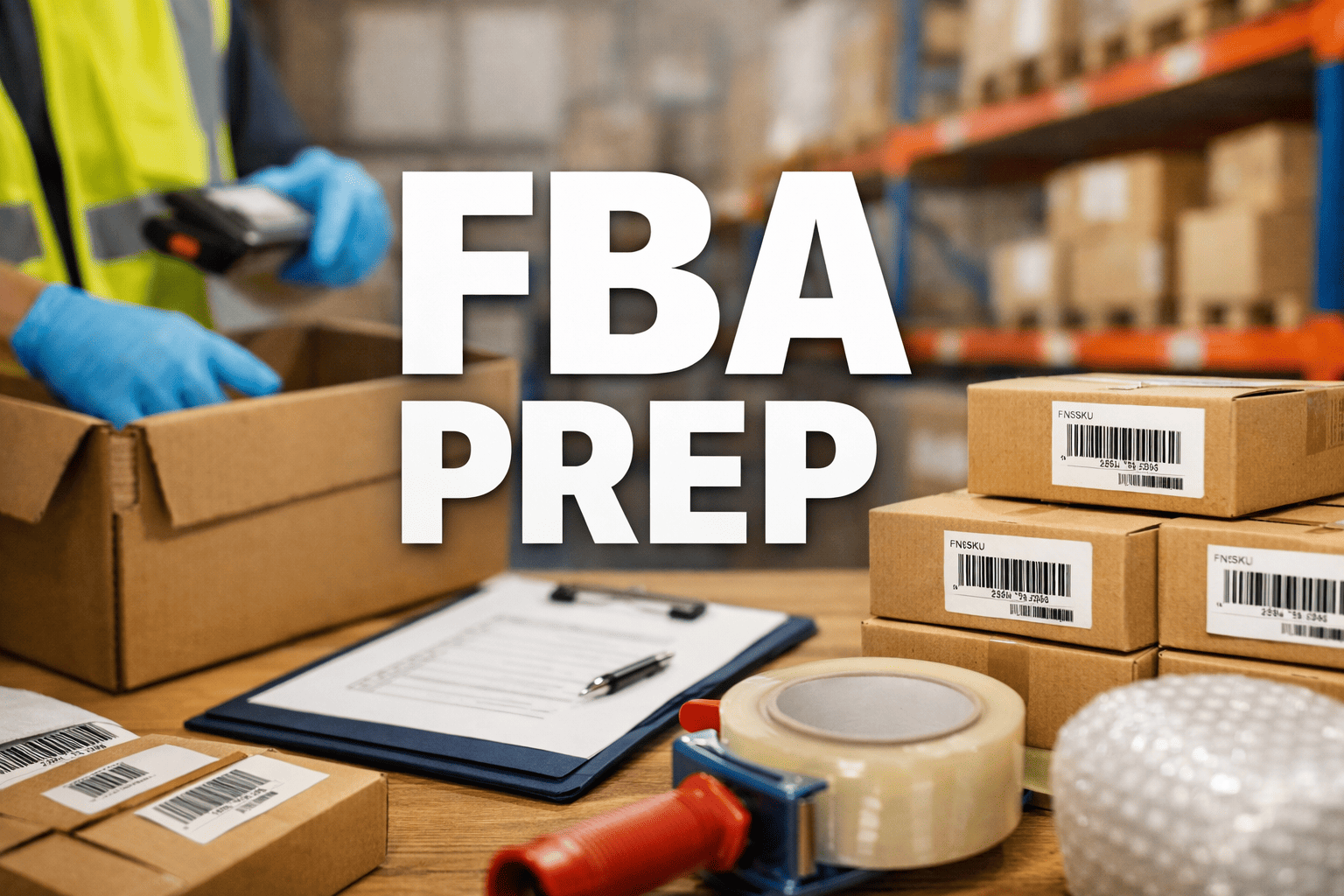
FBA Prep is the process of preparing your inventory to meet Amazon’s strict fulfillment standards. It includes quality inspection, precise packaging requirements, FNSKU labeling, and more. Proper prep ensures items are machine-readable and warehouse-ready, preventing exception handling, per-unit charges, or account health issues.
Additionally, shipments that arrive without proper prep and item labeling won’t be eligible for reimbursement if damaged or untraceable; they may even be removed from the network.
What Does Amazon FBA Stand For?
FBA stands for Fulfilled By Amazon. This means that your inventory arrives at the Amazon warehouses as ready-to-ship goods at the unit level. Then Amazon handles the fulfillment side, including picking, packing (where applicable), and shipping to the end customer.
While some sellers manage prep internally, others rely on Amazon FBA prep service providers to optimize processes and costs and make sure inventory meets all FBA requirements before it enters the network.
For growing sellers, outsourcing FBA prep can be a practical way to improve consistency, reduce avoidable inbound issues, and increase customer satisfaction.
Key Requirements Of FBA Prep
Here are the key requirements for FBA prep. Depending on the category your product falls into, though, you may need to meet additional guidelines.
Core Packaging Requirements
Amazon’s packaging standards help products move through the fulfillment network without damage, scan issues, or delays.
General Unit Requirements
- Every product must be contained within a single, secure package, ready to ship.
Packages should protect against dust, leakage, or damage. - Units cannot have loose parts that could separate during handling (Amazon will not assemble multiple pieces for you).
- Fragile items may require over-boxing if standard packaging is not sufficient.
Poly-Bagging Rules
- Warning Requirements: Poly bags with an opening of 5 inches (12.7 cm) or larger (measured when flat) must have a legible suffocation warning printed on the bag or attached as a label. The warning is also recommended (but not required) for smaller openings.
- Material Standards: To align with FBA’s poly-bagging guidelines, bag thickness must be at least 1.5 mil. (0.0015 inches / 0.00381 cm). The bag must also be clear, except where Amazon allows otherwise.
- Sealing & Protrusion: In FBA, bags should be fully closed and secured with tape or adhesive. The poly bag or shrink wrap must not protrude more than 3 inches (7.62 cm) past the product’s dimensions.
Fragile, Sharp, & Heavy Units
- Drop Testing: Any items that need bubble-wrapping must pass a 3-foot (1m.) drop test onto a hard surface for 5 consecutive times without breaking or causing the packaging to burst. Smaller damage to the item’s container is, however, acceptable.
- Over-Packaging: Fragile products may require at least two layers of bubble wrap and/or over-boxing, especially if they do not pass the initial 3-foot drop test.
- Sharps Protection: Sharp products must be secured in puncture-resistant packaging to prevent edges from becoming exposed during handling.
- Heavy Units: Items weighing more than 10 lbs (4.5 kg) or containing sharps must be housed in double-wall corrugated boxes.
Labeling Requirements
Proper labeling is the only way Amazon can accurately track your inventory.
While some products may use a manufacturer UPC or other type of barcode, the FNSKU is the standard Amazon barcode and is highly recommended – or even mandatory for certain categories.
Manufacturer Barcodes (UPC/EAN)
If you are a brand owner, you can use manufacturer barcodes (UPC/EAN) without additional stickers, provided that your products:
- Are in ‘New Condition’
- Have a single, scannable UPC/EAN/ISBN that matches a single ASIN in the Amazon catalog.
- Are associated with a brand enrolled in the Amazon Brand Registry.
Exclusions: Products with expiration dates, topicals (cosmetics, personal care, etc.), or products for children/infants usually require an Amazon barcode (FNSKU) instead.
Amazon Barcodes (FNSKU)
Most sellers utilize FNSKU (Fulfillment Network Stock Keeping Unit) labels. FNSKUs are tied to your seller account and must be unique to a specific product (including variations in size, color, condition, etc).
Key Labeling Rules For Amazon FBA Prep:
- Remove/cover any old barcodes or render them unscannable.
- Place the appropriate labels on a flat, unobstructed surface (no corners, curves, or edges).
- All Amazon barcodes (FNSKUs) must be printed in black ink on white labels (non-reflective with removable adhesive). Dimensions must be between 1×2” (2.54×5.08cm) and 2”×3”(5.08× 7.62cm).
- All labels must be high-resolution and scannable, including the barcode itself and the human-readable numbers. Opt for laser and thermal printing.
- For items sold together as a single unit: Clearly mark them as “Sold as Set” or “Do Not Separate.”
- The ASIN or FNSKU identifier must appear on the label alongside the product name and item condition designation.
Shipping Carton & Weight Limits
Following Amazon FBA Prep carton requirements helps avoid unplanned fees or shipment rejections.
Weight Limit
Standard shipping cartons must weigh less than 50 lbs (22.68 kg) unless they contain a single oversized unit that exceeds that weight. For palletized freight, the total pallet weight should not exceed 1,500 lb (680 kg).
Size Limit
Boxes must not exceed 25 inches (63.5 cm) on any side unless the product itself is larger.
Dunnage
Use approved packing materials like air pillows or full sheets of paper.
Do not use: Packing peanuts, shredded paper, or crinkle wrap.
Shipping Labels
Each shipping carton must have a unique FBA Box ID label. For palletized shipments, these box labels should face outward; place additional pallet labels at the top-center of all four sides.
Pallet Standards
For palletized freight, use standard 40 x 48-inch (101.6 x 121.9 cm) GMA Grade B wooden pallets. Stack height must not exceed 72 inches (182.8 cm). Secure the load with clear stretch wrap.
Documentation
For LTL/FTL shipments, you must have the Bill of Lading (BOL) ready for the carrier. Your BOL should accurately list all Amazon Reference IDs, FBA Shipment IDs, and handling-unit quantities, including pallet and box counts.
Expiration & Specialized Dates
For products with temporal requirements, follow these FBA expiration date rules:
Date Format
Expiration dates must follow the MM-DD-YYYY or MM-YYYY format. If the original manufacturer date is different, it must be covered by a compliant sticker.
Font Size
For outer boxes containing expiration-dated products, the date must be printed in 36-point or larger font.
Shelf Life
Expiration-dated products must typically have at least 90 days of remaining shelf life at the time of check-in.
How To Prep Electronics For Amazon FBA
Beyond the standard FBA prep requirements above, electronics logistics for Amazon come with additional safety and compliance requirements.
Anti-Static Protection
All sensitive electronic components must be housed in anti-static bags to prevent damage from electrostatic discharge during sorting and transit.
Lithium Battery Compliance
Safety protocols for batteries are strictly enforced in the Amazon FBA program:
- State of Charge: Under the current (2026) Amazon battery guidance for lithium-ion batteries packed with products, specifically those above 2.7 Wh, Amazon must be able to confirm that they’re charged at 30% state or less.
- Documentation: Every shipment containing lithium batteries must include a UN 38.3 test summary.
- Required Marking: The exterior packaging should clearly display a red battery mark to notify logistics personnel of the presence of hazardous materials.
Region-Specific Requirements
Electronics should match the voltage, plug type, and electrical standards of the destination market.
Manuals, instructions, and safety warnings also need to appear in the primary language of the marketplace.
Why Does Amazon Have So Tight FBA Prep Requirements?
Well, what Amazon aims for is speed, efficiency, and above all, a great buying experience, from checkout to final delivery.
Customer Experience Comes First
This means that any mismatch with strict FBA packaging and prep standards can cause a chain reaction of operational misalignments. More importantly, it can lead to 1-star reviews when customers receive delayed shipments, damaged items, or, worse yet, the wrong product.
As an Amazon expert writes, “One operational hiccup at the prep stage becomes a one-star review three weeks later.”
Amazon FC Automation Relies On Prep Accuracy
Also consider that Amazon’s fulfillment network is built around large-scale automation, with advanced robotics, extensive conveyor systems, and software that controls more than half a million mobile robots across hundreds of sites.
In that kind of environment, each item must be meticulously packaged and labeled with the right FNSKU and according to FBA prep requirements so it can move through the network efficiently.
What Is SIPP In Amazon?
For eco-conscious brands or those that wish to offer a more branded experience to their customers, Amazon retains their SIPP (Ships In Product Packaging) program for enrolled sellers and for products that meet relevant requirements – avoiding additional “smile-logo” packaging.
What Do FBA Prep Centers Do?
Outsourcing all inventory handling to an FBA Prep provider includes these core services:
-
- Quality Inspection: Checking for defects, damage, or other issues.
- Labeling: Applying scannable barcodes (FNSKU) labels to meet Amazon’s requirements.
- Protective Packaging: Bagging, bubble-wrapping, taping, or boxing items based on Amazon’s prep standards.
- Shipping Preparation: Ensuring outer cartons meet Amazon’s weight and size limits, and shipment-readiness requirements.
- Omnichannel Distribution: For advanced operators, the strategy extends to multi-channel fulfillment, where a single inventory pool at the prep center can be used to fulfill orders from eBay, Amazon, and your own website simultaneously.
Will Amazon FBA No Longer Offer Prep Services?
Not anymore. For over a decade, Amazon had been offering in-house prep and labeling services for shippers. However, this service is no longer available, so sellers must prep their inventory in-house or through third-party Amazon FBA prep services.
The reason why Amazon ended this service is that, today, as sellers’ packaging capabilities improve and Amazon 3PL fulfillment services see wider adoption, there’s no business-critical need for Amazon’s prep offerings.
Instead, FBA can now focus on “providing faster and more efficient fulfillment center operations,” the company declares.
Outsourcing FBA Prep As Part of Your Strategy
Outsourcing your inventory preparation to third-party FBA Prep services transforms a logistical hurdle into a predictable per-unit cost. Plus, you shield your inventory from shipment rejections or account “red flags” due to non-compliance.
Professional FBA prep centers keep up with Amazon’s shifting requirements. They also usually offer storage solutions that let you feed inventory into Amazon in smaller waves, helping reduce exposure to aged inventory surcharges when demand slows.
For Electronics Brands, Green Wave Electronics Delivers More Than Standard FBA Prep
Alongside compliant labeling, packaging, and fast-turnaround support, Green Wave Electronics offers refurbishment services that help recover value from returns and restore more units for resale through channels like Amazon Renewed.
That means less waste, stronger margins, and more inventory turned back into revenue.
Prep smarter. Recover more. Talk to Green Wave Electronics today.
FAQs
What Is An Amazon Prep Center?
An Amazon prep center is a third-party facility that prepares, packages, and labels inventory to meet strict FBA guidelines. It performs inspections, labeling, and packaging to ensure compliance, so that sellers can focus on scaling their business.
What Is An FNSKU?
An FNSKU (Fulfillment Network Stock Keeping Unit) is a unique, alphanumeric code used by Amazon to identify and track specific inventory items within their fulfillment centers.
What Is An Amazon FBA Shipment ID?
An FBA Shipment ID is a unique identifier assigned to a specific inbound shipment you create in Seller Central. It helps Amazon track that shipment through the receiving process and links each box to the correct shipment record.
What Is An Amazon Reference ID?
The Amazon Reference ID is an Amazon-generated identifier for a shipment. Carriers use it, along with the FBA Shipment ID, to schedule a delivery appointment through Amazon’s Carrier Central process. You can find the Amazon Reference ID on the Summary page of the shipping workflow in Seller Central, and you should include it on the Bill of Lading for your shipment.